Why Your Oklahoma Service Area Pages Are Failing to Attract Neighboring Customers
You have a thriving business based in the heart of Tulsa. Your office is pristine, your crew is the best in the state, and your local reputation is rock solid. Yet, when a homeowner in Broken Arrow, Jenks, or Owasso searches for your services, your business is nowhere to be found. It is the “Ghost Town” problem of google business profile seo: you exist in one spot, but you are digitally invisible just ten miles down the road. Many Oklahoma business owners believe that simply listing these neighboring cities in their website footer or creating a few “cloned” pages will bridge the gap. In reality, these low-effort tactics are exactly why your service area pages (SAPs) are failing.
In the modern search landscape, Google has shifted its algorithm to prioritize “proof of local relevance” over simple keyword mentions. It is no longer enough to tell Google you serve a city; you must prove to the algorithm that you are an active, authoritative participant in that specific community. If your service area pages feel like a digital desert, you aren’t just losing clicks – you are handing your market share to competitors who understand the nuances of hyperlocal search.
The “Clone” Trap: Why Template Pages Are SEO Poison
The most common mistake Oklahoma businesses make is the “Find and Replace” strategy. A roofer in Tulsa creates one perfect page, then copies it ten times, changing only the word “Tulsa” to “Bixby,” “Sapulpa,” or “Sand Springs.” To a human, it looks like a list of locations. To Google, it looks like “thin content” or, worse, “doorway pages.”
Google operates with something called “Indexing Bandwidth.” For small to mid-sized local businesses, Google does not have an infinite desire to crawl and index every single page you publish, especially if those pages offer zero unique value. When the algorithm sees ten identical pages with only the city name swapped out, it often chooses to index the primary page and ignore the rest. This results in your “Broken Arrow” page never even appearing in search results, regardless of how many keywords you’ve stuffed into the headers.
Furthermore, these templates fail to address the specific needs of different Oklahoma communities. The plumbing issues faced by a homeowner in a historic Midtown Tulsa bungalow are vastly different from those in a brand-new development in suburban Owasso. By failing to differentiate your content, you miss out on the long-tail keywords that actually convert. This is one of the 3 Tulsa Local SEO Mistakes Crushing Your 2026 Rank [Checklist] that we see most frequently. If your pages aren’t indexed, they can’t rank; if they don’t rank, your phone doesn’t ring.
Proximity vs. Relevance: The Battle for the Map Pack
When it comes to local map pack seo, there is a constant tug-of-war between proximity (how close you are to the searcher) and relevance (how well you fit the search intent). Google’s “Local Filter” has become increasingly aggressive. As competitor density increases in the Tulsa metro area, your “ranking radius” naturally shrinks. Google wants to provide the most immediate and relevant result to the user.
Research data shows a clear trend: the more businesses Google has to pick from in a specific area, the smaller your ranking radius becomes. If you are based in South Tulsa, you might naturally rank for “plumber near me” within a 3-mile radius. But to rank in Jenks – just across the river – you need more than just proximity; you need overwhelming relevance. To expand this radius, a standard website isn’t enough; you need comprehensive google business profile optimization.
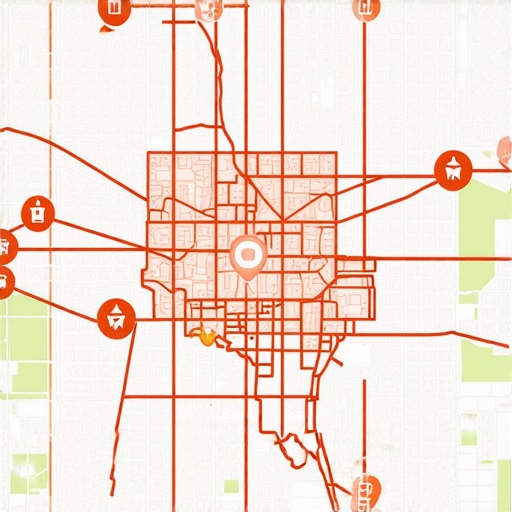
To understand how your visibility fluctuates across different neighborhoods, savvy business owners use google maps seo tools. These tools allow you to see a grid-based view of your rankings. You might find you are #1 at your office, but drop to #15 the moment you cross the city line into Broken Arrow. Overcoming this “Local Filter” requires you to feed Google’s algorithm signals that prove you aren’t just a Tulsa business that *drives* to Bixby, but a business that is a *fixture* of the Bixby community.
5 Reasons Your Oklahoma City Pages Are Ghosting You
1. Lack of Hyperlocal Content
Most SAPs are generic. They talk about “quality service” and “affordable pricing.” To rank in 2026, you need to mention local landmarks and specific geographic markers. If your Broken Arrow page doesn’t mention the Rose District, or your Tulsa page ignores the Gathering Place or the specific soil conditions of the Arkansas River basin, Google views the page as a generic placeholder. Hyperlocal content tells the algorithm you actually know the area.
2. Missing NAP Consistency
For Service Area Businesses (SABs) that hide their physical address, Name, Address, and Phone (NAP) consistency is even more critical. Even if you don’t have a storefront in every city, your service area boundaries must be clearly defined and consistent across your website and your Google Business Profile. Discrepancies between what your website says and what your GBP says will lead to the reason your Tulsa shop is missing from local map packs.
3. Zero Local Social Proof
Google’s algorithm is smart enough to read the text within your reviews. If all your reviews mention “Tulsa” but your “Glenpool” page has zero mentions of Glenpool customers, you lack the “social proof of location.” You need to actively solicit reviews from customers in your outlying service areas and, if possible, encourage them to mention their city name in the review text. A testimonial from a customer in Owasso on your Owasso SAP is worth ten generic reviews on your homepage.
4. Poor Mobile Performance
Local search is inherently mobile. Whether someone is searching for an emergency locksmith while standing in a parking lot in Catoosa or a family lawyer while at lunch in downtown Tulsa, they are using a smartphone. If your service area pages are heavy, slow-loading, or difficult to navigate on a mobile device, Google will demote them. The “near me” intent is almost exclusively mobile-driven.
5. The 2026 AI Filter
As we move into 2026, AI-driven search (like Google’s Search Generative Experience) is becoming the primary way users find information. These AI models look for “verified” and “authoritative” signals. They favor businesses that have a deep web of connections – links from local Oklahoma chambers of commerce, mentions in local news outlets like the Tulsa World, and content that demonstrates “E-E-A-T” (Experience, Expertise, Authoritativeness, and Trustworthiness). A thin, templated city page will never pass the AI filter.
The “Hyperlocal” Blueprint: How to Fix Your SAPs
Fixing your service area pages requires a move away from quantity and a move toward quality. Instead of 50 thin pages, aim for 5-10 robust, “hyperlocal” hubs. Here is the blueprint for a high-performing SAP in the Oklahoma market:
- Unique Local Statistics: Include data relevant to the city. For a roofing company, this might be “Average age of roofs in the Forest Ridge community” or “Common hail damage patterns in Wagoner County.”
- Custom Map Embeds: Don’t just embed a static map of your office. Embed a custom Google Map that outlines your specific service zone for that city. This provides a direct signal to Google about your operational boundaries.
- City-Specific FAQs: Answer questions that people in that specific town are asking. “Do you provide emergency plumbing services near the Creek Turnpike?” or “How do Bixby’s local zoning laws affect residential fence installation?”
- Local Imagery: Use photos of your trucks parked in front of recognizable local landmarks or in specific neighborhoods. Geotagging these images (adding metadata for the specific city) adds another layer of local relevance.
To ensure these changes are actually moving the needle, you should utilize a google maps ranking service. This allows you to track your progress not just by city, but by neighborhood. In a sprawling metro area like Tulsa, “ranking in Tulsa” is too broad. You need to know if you are ranking in Cherry Street vs. Brookside vs. Turley. This granular data is the only way to refine your service area business seo strategy effectively.
Preparing for 2026: The “Verified Only” Map Pack
The future of google business profile seo is heading toward a more stringent verification model. To combat the plague of “ghost offices” and lead-gen spam, Google is increasingly requiring video verification and proof of physical presence. For Oklahoma businesses, this means that your digital footprint must match your real-world activity.
We predict that by 2026, the Map Pack will move toward a “Verified Only” model where businesses without a strong, localized content strategy on their website will be relegated to the second or third page of results. The “set it and forget it” era of GMB is over. To drive more local leads, you must treat your Google Business Profile as a living social channel, updated frequently with local posts, photos, and Q&A responses that mirror the content on your service area pages.
DIY local SEO is getting harder. As the algorithm becomes more sophisticated, the gap between the “pros” and the “amateurs” widens. If you aren’t using professional google business profile seo tools and strategies, you are essentially flying blind in a very competitive storm.
Conclusion: Stop Losing Local Leads
Your Oklahoma service area pages should be your hardest-working employees, bringing in leads from every corner of the metro area while you sleep. If they are failing, it is because they lack the unique local authority that Google now demands. By combining unique, hyperlocal content with technical google business profile optimization, you can break through the Local Filter and dominate the Map Pack.
Remember: Unique content plus technical authority equals rankings. Don’t let your competitors in Broken Arrow and Jenks take your customers just because your website is stuck in 2015. It’s time to implement Oklahoma’s Local Marketing Blueprints: Win Over Customers and reclaim your territory.